1
/
of
1
Imprec
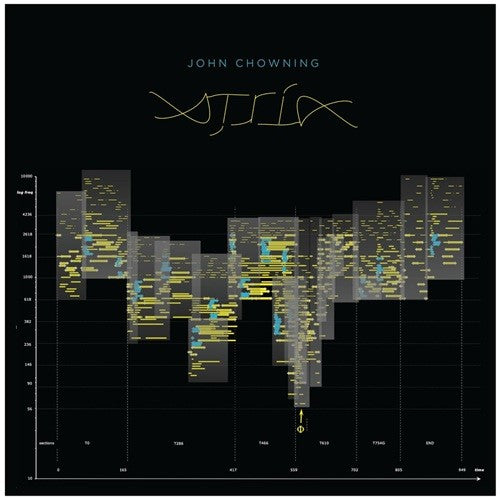
Chowning, John - Stria
Chowning, John - Stria
Regular price
£27.99 GBP
Regular price
£0.00 GBP
Sale price
£27.99 GBP
Unit price
/
per
Tax included.
Couldn't load pickup availability
Dr. John Chowning (b. 1934) is a pioneering computer musician,composer and professor who, in 1967, discovered the FM synthesis algorithm. This breakthrough in electronic music allowed for simple,yet rich timbres described as sounding "real."
With this discovery, Chowning composed singular, dramatic electronic music and changed thetimbre of music forever. Chowning utilized the potential of computers to synthesize sounds according to programmed instructions. The composer's use of his own FM algorithms, digital synthesis with computers and the new compositional concepts offered by a programmable musical structure combine to create some of the most original and unique electronic music ever created.
The compositions on this LP were realized between 1966 and 1981 and the music on this LP, with the exception of Stria, was originally released on CD in Germany (Wergo, 1988). The version of Stria included here contains a section not included on the Wergo CD. Thus, this version of Stria is complete. This is the first time these purely digital recordings have been released on an analog medium.
The original dynamics of these groundbreaking compositions have been preserved on this LP. As a result, listeners are advised to increase volume with caution.In 1975, John Chowning founded the CCRMA - Center For Computer Research In Music and Acoustics at Stanford University. Through Stanford, Chowning licensed his groundbreaking algorithms to Yamaha resulting in numerous new instruments including the iconic DX seriesof keyboards. In 1972, his composition Tureens which is included onthis LP, was the first to create the illusion of continuous 360-degreespace using four speakers.Technical NotesAll pieces on this LP are originally quadrophonic. The illusion ofmoving sound sources is thus projected from the surrounding environment given by four loud-speakers on the stereo-basis.STRIA was composed using Chowning’s own program to compile the musical structure into note-lists and MUSIC 10 (by D. Poole/Tovar) to generate the sounds in software-synthesis.
The original quadrophonic version utilized 12 bits, two different sampling rates being used to accommodate the enormous amount of data on the magnetic disc-packs available at that time. The original sound-data was processed by sampling-rate conversion and digital mixes to achieve the stereoversion presented on this disc. SABELITH and TURENAS were synthesized originally using Smiths’ SCOREand MUSIC 10. However, their format was changed from direct sound-samples to a command stream for a special purpose computer, the SystemConcepts Digital Synthesizer, designed by Peter Samson, one of the first large-scale digital synthesizers for real-time sound processing- one was designed for CCRMA in the late seventies. For this recording, the sounds were recorded directly from the synthesizer computing thesamples in real-time. PHONE was realized with the System Concepts Digital Synthesizer using again Chowning’s own program to create the note list. The master tape of this disc was made directly from the computer system at CCRMA which generated and stored the sound data in digital format.No analog recording was involved at any stage of the production andediting process.
With this discovery, Chowning composed singular, dramatic electronic music and changed thetimbre of music forever. Chowning utilized the potential of computers to synthesize sounds according to programmed instructions. The composer's use of his own FM algorithms, digital synthesis with computers and the new compositional concepts offered by a programmable musical structure combine to create some of the most original and unique electronic music ever created.
The compositions on this LP were realized between 1966 and 1981 and the music on this LP, with the exception of Stria, was originally released on CD in Germany (Wergo, 1988). The version of Stria included here contains a section not included on the Wergo CD. Thus, this version of Stria is complete. This is the first time these purely digital recordings have been released on an analog medium.
The original dynamics of these groundbreaking compositions have been preserved on this LP. As a result, listeners are advised to increase volume with caution.In 1975, John Chowning founded the CCRMA - Center For Computer Research In Music and Acoustics at Stanford University. Through Stanford, Chowning licensed his groundbreaking algorithms to Yamaha resulting in numerous new instruments including the iconic DX seriesof keyboards. In 1972, his composition Tureens which is included onthis LP, was the first to create the illusion of continuous 360-degreespace using four speakers.Technical NotesAll pieces on this LP are originally quadrophonic. The illusion ofmoving sound sources is thus projected from the surrounding environment given by four loud-speakers on the stereo-basis.STRIA was composed using Chowning’s own program to compile the musical structure into note-lists and MUSIC 10 (by D. Poole/Tovar) to generate the sounds in software-synthesis.
The original quadrophonic version utilized 12 bits, two different sampling rates being used to accommodate the enormous amount of data on the magnetic disc-packs available at that time. The original sound-data was processed by sampling-rate conversion and digital mixes to achieve the stereoversion presented on this disc. SABELITH and TURENAS were synthesized originally using Smiths’ SCOREand MUSIC 10. However, their format was changed from direct sound-samples to a command stream for a special purpose computer, the SystemConcepts Digital Synthesizer, designed by Peter Samson, one of the first large-scale digital synthesizers for real-time sound processing- one was designed for CCRMA in the late seventies. For this recording, the sounds were recorded directly from the synthesizer computing thesamples in real-time. PHONE was realized with the System Concepts Digital Synthesizer using again Chowning’s own program to create the note list. The master tape of this disc was made directly from the computer system at CCRMA which generated and stored the sound data in digital format.No analog recording was involved at any stage of the production andediting process.
Share